What is Software Worth when Everyone Writes Software?
AI is making (some) software cheaper and easier to build. That doesn't make all of it worth less.
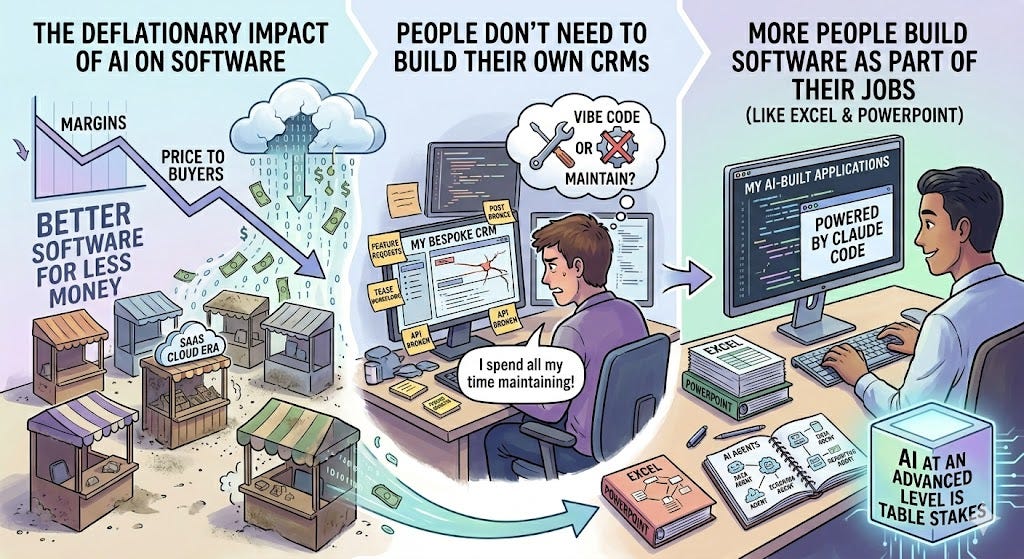
Ever since the first wave of the Saaspocalypse, I’ve been thinking a lot about the nature of the software business. While I think the first wave was a bit overdone, the general idea that AI will cause major disruptions to the software business is hard to deny. If you invest in private companies or work at a startup, this isn't news to you; you’ve seen this over the past three years. The public markets are still in the early phase of digesting what those in the private markets have been grappling with for years. Two core thoughts have really occupied my mind for the last few months:
AI is having and will continue to have a deflationary impact on the software business. The attractive gross margin profile of software companies was a combination of low marginal unit cost (still true), high cost of production due to the limited supply of talented software developers (still true, but less important), and the people-hours required to catch up to existing products using traditional software development processes in a pre-AI era (no longer true). Selling software will likely remain a good business, but probably not as great as it was during the SaaS cloud era. This is great for software buyers, by the way - you’ll get better software for less money, and buyers will capture more of the value of software than they did in the cloud era. To me, this feels well understood by most people in the market.
For better or for worse, the deflationary impact of AI means that more people will write more software for use cases we couldn’t previously imagine. This last part is the one I have been living through personally, and that is still not fully explored. I think the tokenmaxxing era obscured some of the more interesting things happening as people burned tokens on inefficient applications, workflows, and processes that maybe didn’t even need to be built. As that fog lifts, a few things will become clear.
People Don’t Need to Build Their Own CRMs
One predictable byproduct of the “end of software” narrative was the idea that nobody would pay for software anymore. Why pay for software when you can vibe code a prototype version of something you already pay for? CRM platforms seemed like the first target of this thinking - why pay for Salesforce or Hubspot when you can rebuild most of the functionality using a coding agent? You can have a CRM that’s perfectly suited to your needs and workflow without paying a vendor, so long as you exclude the value of the time you spend developing the application, maintaining it, or the cost of the tokens you spend running it.
I noticed a really common pattern when I talked to people going down this route. There was initial euphoria about building something that worked and exactly matched their workflow. Then things broke or didn’t work quite as planned. Then teammates started requesting feature requests and updates and lo and behold the person who created the first version had to become a software developer and product manager of their own creation. I am not sure there is a strong argument for building bespoke versions of products when the potential consumer audience is large; many people need CRM systems, and I bet most companies are better off customizing an existing product than rolling their own from scratch. Part of what you pay for when you license a cloud product is making the challenge of keeping current with APIs, building new features, and generally keeping things running to someone else. That is still valuable today. The difference is that I don’t think you can extract as much as a vendor for doing that work as before.
Single User Software - No Market, but Very Valuable
One of the things I didn’t fully grasp until I started building software for myself using AI coding assistants is the rapid growth in software applications for single users. What makes these products interesting to me is that they are so bespoke you would not have paid a software developer to build them for you because doing so would have been cost-prohibitive in the pre-AI era. I also doubt any developer would have pursued these products as a for-profit business because the market was too small.
We are in the very early innings of understanding what it means to have many applications with only a single user per product. That single user will continue to develop and support the product for as long as it remains useful and as long as the time and energy required to use it feel worthwhile. If that balance tips and it no longer feels useful, those products will die. I don’t believe there is a business to be built here, but this idea of single-user software really connects to another thing I have only recently begun to fully internalize as I’ve built roughly two dozen agents that I use regularly at Precursor.
So what does all of this mean for what software is worth? The picture is murky, and the impact depends on the product's nature. Basic, utility applications with a narrow scope will face consistent downward pricing pressure from the threat that the end user will just build the product themselves. They might never build it, but the belief they could build it will make them more price-conscious and skeptical of paying more for products that deliver narrow value propositions. The result isn't uniform deflation - it's a split. Products that require maintenance, new feature development, integrations, and the ability to interact with the customer’s AI tooling and infrastructure will still be purchased, as buyers won’t want to do all that work themselves. The experience of being a junior builder will reinforce the value of this work to the buyer, but they won’t pay software-like margins for it; it will be valued, but less than what software vendors are used to getting from license revenue.
More people will build software as part of their jobs, much like they use Excel and PowerPoint
I am not a software developer in the traditional sense - I never studied CS in college, and I’ve never mastered or learned a real programming language. In the last year or so, I’ve gone pretty deep in learning how to build applications with Claude Code as my partner. I went from someone who couldn’t use GitHub to someone who now can build useful applications for myself that solve real business problems in my job as a VC. I’ve learned enough Python concepts to have Claude Code help me build what I want and make it reasonably efficient, but I would never confuse myself with a professional software developer.
In many ways, my relationship to coding is similar to my relationship with Excel. I know how to use Excel and get a lot of value out of the tool. I am not nearly as skilled at using Excel as my friends who worked in investment banking or private equity; their jobs required far greater mastery of the product than mine did, so they know way more about it than I do. I could say the same about my friends who work in consulting and their relationship to PowerPoint.
I was struggling to put my thoughts on this topic into words until I listened to this interview between Casey Newton from Platformer and Boris Cherny from Anthropic. I think we are rapidly moving into a world where the ability to use AI at an advanced level (beyond simple prompts in a chatbot) will be table-stakes skills for white-collar jobs; in some domains, notably entry-level venture capital jobs, this is already largely the case.
I don't have this fully worked out, and things are shifting really quickly. This might be out of date by the time I publish it! When I zoom out, I think model providers, whether closed- or open-source, will be the primary beneficiaries of single-user software applications; budgets for those products will be capped (no more tokenmaxxing) but still available, provided the application is, in fact, valuable. I also suspect that support and maintenance will become more important as the sheer volume of machine-generated code will mean that fewer humans will really understand any company’s codebases or the decisions made by coding assistants or agents. Keeping these applications up and running and up to date with the latest advances in AI will continue to be a challenge. There will still be money in the software business, just perhaps not as much and not at the same margins that we’ve become used to as investors and founders.
There's a reason we hire plumbers...to fix DIY projects gone wrong. But, we don't hire plumbers to work on our teeth. They are great at what they do, they know that, they stay in their lane. And, the DIYers learn some very valuable lessons along the way.
This is why building your own CRM is a really bad idea. That being said, not all plumbers are the same and not all their solutions are the same. Some are clearly better at what they do. It's up to the customer to do their research and hire the best for the job to be done.
Connecting the dots, it's possible that single-user (and small-team) software built on top of SaaS can be value-accretive to both parties.
Even after accepting the advantages of SaaS—security, maintenance, data complexity, and the need for a shared source of truth—limitations still exist. High cost is often one, but more significant is that these platforms are built to be most things to most people. As such, they tend to be either overly abstracted, built to serve the lowest common denominator, or both. This sets a ceiling on the value available to customers.
In comes AI coding tools, which make it tractable for single users and small teams to build bespoke solutions that leverage the benefits a SaaS platform can provide. What was a ceiling becomes the floor. This increase in value capture by users, combined with the lower baseline cost for SaaS noted in the article, expands the provider's addressable market. This could be a case where lower margins are offset by higher volume.